

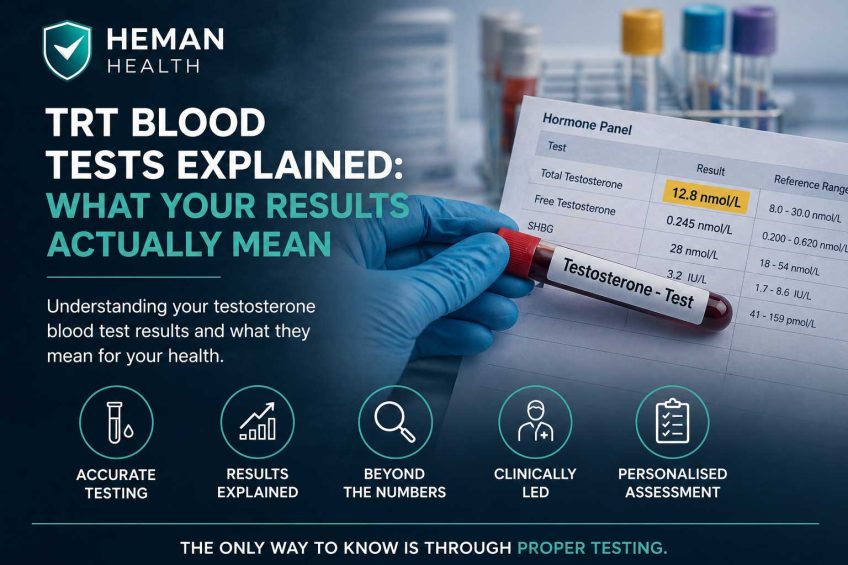
You’ve had a testosterone blood test. You’ve got a number. But what does it actually mean? This is where most men get stuck. You’re told your levels are “normal”—but you still don’t feel right. Or you’re given a result with no real explanation of what it means for you. Understanding testosterone blood test results isn’t just about the number. It’s about context, timing, and how those results relate to your symptoms.
Why Testosterone Results Can Be Confusing
One of the biggest issues with testosterone testing is the “normal range”. Most lab reports will show something like: Reference range: 8 – 30 nmol/L. If your result falls within that range, it’s often labelled as “normal.” But that doesn’t tell the full story.
Two men can have the same testosterone level and feel completely different. One may feel fine, while the other experiences fatigue, low mood, and reduced libido.
This is because:
- Testosterone levels vary between individuals
- Symptoms matter just as much as the number
- Other hormones influence how testosterone works in the body
This is why a single number, on its own, is not enough.
What Is Actually Measured in a Testosterone Blood Test?
A proper assessment looks beyond just total testosterone.
Total Testosterone
This is the overall amount of testosterone in your blood. It’s the most commonly measured value, but it doesn’t tell you how much is actually available for your body to use.
Free Testosterone
This is the portion of testosterone that is biologically active—meaning it can actually enter cells and have an effect. Some men have “normal” total testosterone but low free testosterone, which can still lead to symptoms.
SHBG (Sex Hormone-Binding Globulin)
SHBG is a protein that binds to testosterone and reduces the amount of free, usable hormone. Higher SHBG levels can result in less available testosterone, even if total levels appear normal.
Other Relevant Markers
Depending on the assessment, additional tests may include:
- LH and FSH (to understand how your body is producing testosterone)
- Oestradiol (which can influence symptoms and balance)
- Prolactin or thyroid markers if clinically indicated
These help build a more complete picture.
What Is Considered “Low” Testosterone in the UK?
There is no single cut-off that applies to everyone.
In general:
- Levels below ~8 nmol/L are typically considered low
- Levels between 8–12 nmol/L may be borderline
- Levels above this may still be associated with symptoms in some individuals
This is why clinical judgement matters. A result should never be interpreted in isolation. It needs to be considered alongside your symptoms, medical history, and overall health.
Why One Blood Test Is Often Not Enough
Testosterone levels fluctuate throughout the day. They are usually highest in the morning and can be influenced by:
- Sleep quality
- Stress
- Illness
- Lifestyle factors
Because of this, guidelines often recommend:
- Testing in the morning
- Repeating the test if levels are low or borderline
This helps confirm whether the result is consistent and clinically meaningful.
When “Normal” Doesn’t Feel Normal
A common scenario is: “My results are normal, but I still feel off.” This is where a structured approach becomes important. There are several possibilities:
- Your testosterone may be on the lower end of normal for you
- Free testosterone may be reduced
- Another underlying issue may be contributing to your symptoms
This is why interpretation is just as important as testing.
When Is TRT Considered?
Testosterone replacement therapy may be appropriate when:
- Symptoms are consistent with low testosterone
- Blood tests confirm low or borderline levels
- Other potential causes have been explored
Even then, the decision is not automatic. TRT is a medical treatment that requires:
- Careful patient selection
- Ongoing monitoring
- A clear understanding of benefits and risks
It should never be started without a proper assessment.
The HEMAN Health Approach
At HEMAN Health, the focus is on getting the diagnosis right before considering treatment.
The process is structured:
- A detailed consultation to understand your symptoms
- Comprehensive blood testing (not just a single marker)
- Careful interpretation of results
- A clear discussion of your options
For some patients, this leads to testosterone therapy. For others, it highlights different areas that need to be addressed. The goal is not to push treatment—it’s to provide clarity.
Final Thoughts
A testosterone blood test is an important first step—but it’s only one part of the picture. Understanding what your results actually mean requires more than reading a number off a report. It requires context, clinical judgement, and a structured approach to assessment. If you’ve had a test and are unsure what it means—or if you’re considering testing for the first time—the key is not to guess. It’s to interpret the results properly and make an informed decision.
Written by Asif Mukhtar
Consultant Pharmacist & Founder of HEMAN Health
Ready to Understand Your Results?
If you’re experiencing symptoms of low testosterone or want a proper, clinically guided assessment, you can learn more or book a consultation